Data Warehouse Design | Estateplanning | Vibepedia.Network
Data warehouse design is a critical component of business intelligence, enabling organizations to make informed decisions by analyzing integrated data from vari
Overview
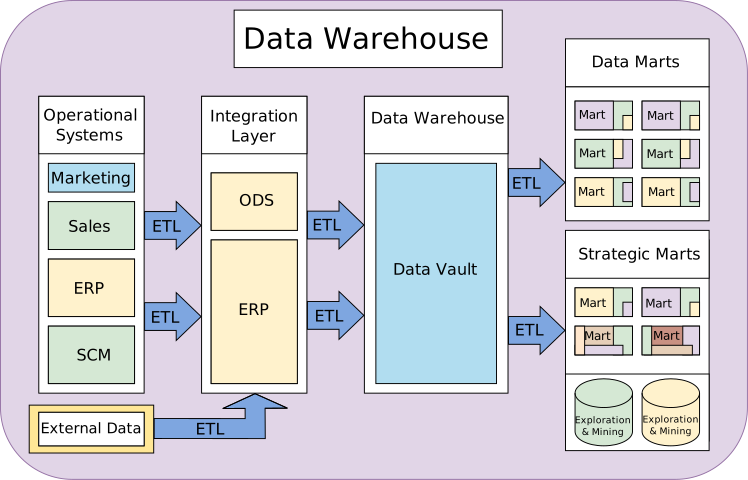
Data warehouse design is a critical component of business intelligence, enabling organizations to make informed decisions by analyzing integrated data from various sources. A well-designed data warehouse stores current and historical data in a structured format, optimized for reporting, analysis, and insight generation. The process involves extracting data from operational systems, transforming it into a suitable format, and loading it into the warehouse. With the help of [[oracle|Oracle]], [[microsoft|Microsoft]], and [[ibm|IBM]], data warehouses have become a crucial tool for businesses to gain a competitive edge. As [[gartner|Gartner]] notes, a properly designed data warehouse can lead to significant improvements in data quality, reduced costs, and enhanced decision-making capabilities. The two primary workflows for building a data warehouse system are extract, transform, load (ETL) and extract, load, transform (ELT), with [[informatica|Informatica]] and [[talend|Talend]] being popular ETL tools. Effective data warehouse design requires careful consideration of factors such as data governance, security, and scalability, as well as the use of [[apache-hadoop|Apache Hadoop]] and [[apache-spark|Apache Spark]] for big data processing. By leveraging these technologies and best practices, organizations can unlock the full potential of their data and drive business success.